

China-Germany Energy Storage Technical Exchange Held at Wuppertal Institute
National Key R&D Project Team Conducts International Exchange with Germany’s Wuppertal Institute
Recently, the project team of the National Key R&D Program project “Assessment of Value Streams and Carbon Emissions of Large-Scale Energy Storage” visited Germany for international exchanges. Project leader Yu Zhenhua and key project member Yue Fen visited the Wuppertal Institute for Climate, Environment and Energy (WI) and held in-depth discussions with Dr. Stefan Thomas, Head of the Energy, Transport and Climate Policy Research Division, and Dr. Chun Xia. The two sides exchanged views on topics including power system flexibility resources, long-duration energy storage technologies, and carbon emissions assessment in China and Germany.
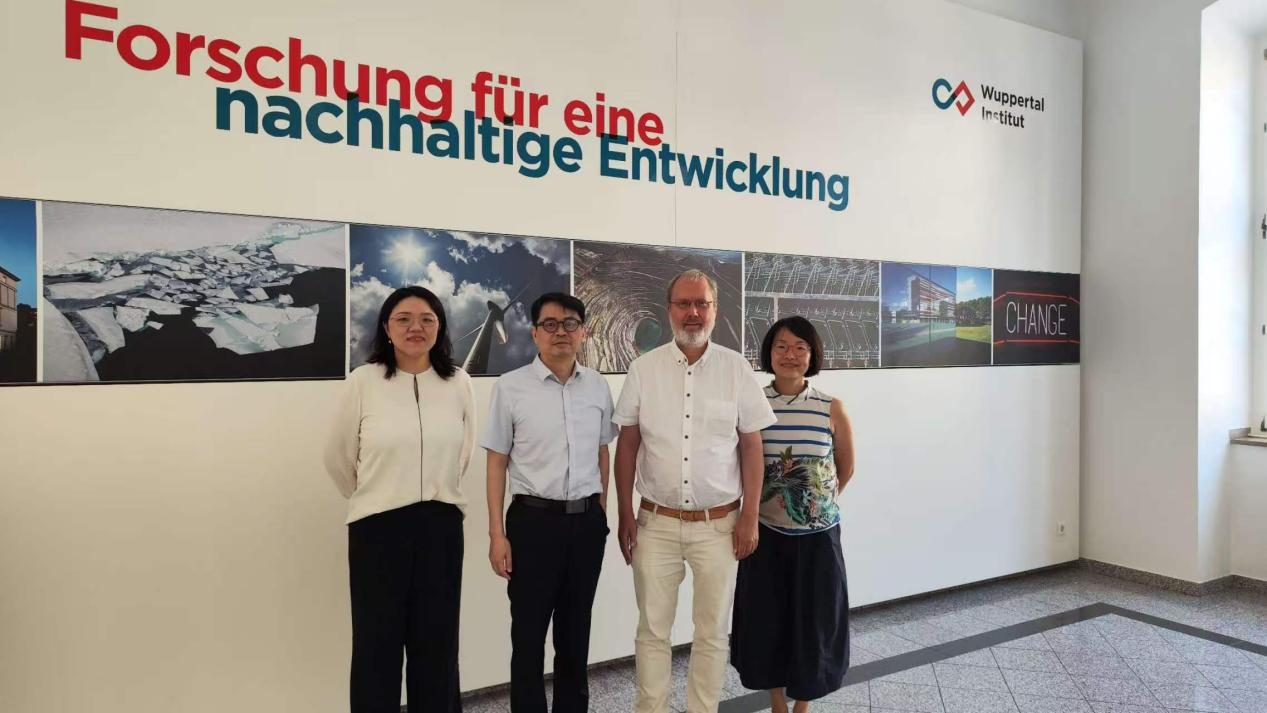
During the meeting, WI first introduced its recent research progress in the field of energy policy. Established in 1991 with funding from the government of North Rhine-Westphalia, Germany, WI has an annual budget of approximately €30 million and a staff of around 320 researchers. The institute focuses on energy transition and industrial policy research.
Dr. Stefan Thomas noted that WI has maintained long-standing cooperation with China and has worked with institutions such as Tsinghua University on building energy efficiency since 2009. He highlighted two major ongoing China–Germany cooperation projects. The first is a Horizon Europe project focusing on low-carbon transformation in the steel and chemical industries. The second, commissioned by the German government, is being conducted jointly with Chinese partners to study power sector transition pathways and energy storage regulatory frameworks.
Regarding power system flexibility in Germany, Dr. Thomas explained that renewable energy now accounts for approximately 58% of the country’s electricity generation. The rapid growth of wind and solar power has increased the demand for system flexibility. Germany has currently deployed about 18 GWh of energy storage, equivalent to roughly 1% of daily electricity consumption. Following the renewable energy share surpassing 50%, large-scale energy storage projects have been expanding rapidly.
As electrification advances across heating, transportation, and industry, Germany’s electricity demand is expected to double over the next 20 to 25 years. In particular, the country faces the challenge of prolonged winter periods with limited wind and solar generation, commonly referred to as “dark doldrums” (Dunkelflaute). To address this issue, Germany has placed long-duration energy storage high on its policy agenda. The government is planning to procure up to 12 GW of gas-fired backup generation capacity through competitive tenders, with a gradual transition toward hydrogen-based solutions. At the same time, policymakers are exploring pathways to facilitate the deployment of long-duration energy storage technologies.
Research conducted by the WI team indicates that low wind and solar output periods lasting more than five consecutive days are relatively rare but represent one of the most significant challenges for all flexibility options within the power system.
Representatives from the China Energy Storage Alliance (CNESA) introduced the latest developments in China’s energy storage market, project implementation progress, and methodologies for comprehensive value assessment. They also shared research findings related to carbon emissions assessment. Both sides agreed that China and Germany face many common challenges in energy storage development and power system transformation, creating significant opportunities for future cooperation.
The exchange received strong support from the German side. Dr. Thomas expressed WI’s willingness to collaborate closely with the project team in areas such as techno-economic assessment of long-duration energy storage, power system flexibility modeling, and carbon accounting methodologies. He also shared WI’s research approaches and data resources related to flexibility resource assessment and energy storage policy analysis.
German experts provided constructive recommendations on the project team’s comprehensive energy storage value assessment framework and expressed their willingness to facilitate access to European energy storage standards, policy research resources, and relevant expertise. These efforts will provide international perspectives and valuable data support for the project's future research activities.
The exchange enhanced mutual understanding in areas including energy storage policy, market mechanisms, and carbon emissions assessment, laying a solid foundation for further China–Germany cooperation on energy storage technologies and standards.